
A gnawing topic
Confronting our society’s appetite for that most horrible taboo

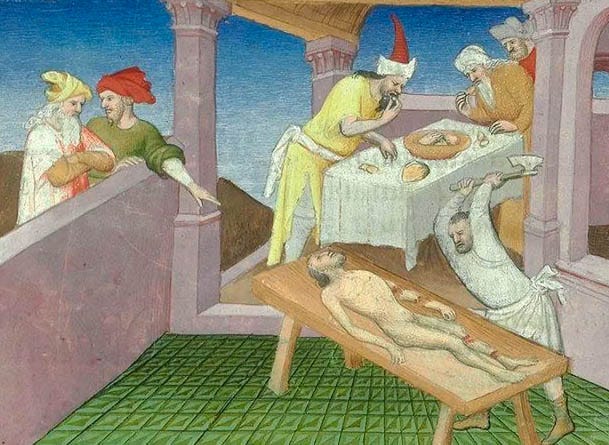
Few topics, if any, have been surrounded by more myths and more fictional treatments than cannibalism. Yet flesh-eating is one of the most avoided and uncomfortable subjects of conversation and scholarship that we might put forward on this day.
Avoid it or not, questions, curiosities and depictions of the taboo subject always seem to creep into our peripheries — seldom invited, but almost never dodged.
We gasp at newscasts about survivors of shipwrecks and plane crashes who make horrid decisions to stay alive. Then, we repeatedly retell the story of the Donner Party from the Gold Rush era in California’s Sierras, complete with reimagined ink drawings of the 1840s snowbound scenes.
We are all aghast when a deranged killer like Jeffrey Dahmer is captured or convicted and it is revealed that he ate body parts of his 16 young boy victims. But then millions of us watch a Netflix docudrama about Dahmer’s life and his serial crimes and we give the series multiple Emmy Awards.
We tell our children the fairytale story of Hansel and Gretel with the child-eating witch and we can’t help watching a few scenes of the movie “Silence of the Lambs,” whenever its flesh-eating connoisseur-villain Hannibal Lector leers from our TV screen or YouTube feed.
The written pages from Shakespeare, Dickens and Herman Melville’s “Moby Dick” and Defoe’s “Robinson Crusoe” all contain characters and passages on the topic. Cult followers dress up in costume every Halloween to watch the movie “Rocky Horror Picture Show” where a mysterious “meat loaf” is served in one of the pivotal scenes.
You didn’t purposely open this Substack post to fulfill a craving about cannibalism, now did you? And, yet, here you are.
Outside of fictional works, cannibalism is considered the “ultimate taboo” in our society although it was widely practiced in older and more primitive cultures. The practice was accepted as parts of various rituals and for attributed medicinal powers. Accounts of cannibalism have been found in Egyptian and Roman histories and from earlier archeological digs of Neanderthals and prehistoric sapiens. Aboriginal tribes of New Guinea were discovered following the practice as late as the 20th century.
Basic biology
Cannibalism is also widespread in nature and biology where many species engage in cannibalism for basic survival, evolution of specific species and a balancing mechanism among creature populations and ecosystems.
Bill Schutt, a zoologist, has written two books on the wide subject: “Cannibalism: A Perfectly Natural History” and “Eat Me; A Natural and Unnatural History of Cannibalism.”
“Eating one’s own kind is completely natural behavior in thousands of species, including humans,” writes Schutt. “Throughout history we have engaged in cannibalism for reasons relating to famine, burial rites, and medicinal remedies.”
Among wide reaches of the animal kingdom, insects, amphibians, sea creatures and well-known large predators like lions and tigers all include cannibalism as a survival necessity. We know about praying mantises and some spiders that eat their mates during their sexual reproductive acts. There are many amphibians, mostly frogs, which eat their own developing embryos for population control and to wean out the weaker offspring. Schutt’s books are large volumes that include hundreds of pages of field surveys of species survival and the contributions of cannibalism to the natural march of evolution of life on our planet.
But the zoologist does not leave out humans in his surveys. He lists the three different types of cannibalism that humans practice: 1) “institutional,” which is what is deemed culturally acceptable, mostly witnessed among long ago civilizations; 2) “emergency,” which is the Donner Party type of cannibalism chronicled among many shipwrecks, airplane crashes and marooned island survivors; and, 3) “pathological,” the Jeffrey Dahmer and Hannibal Lector types.
But Schutt was recently quoted as seeing a “clear shift” in the general public’s interest or “fascination” with cannibalism. He said he has seen it become more palatable to readers of fiction as writers depict cannibals as heroes or underdogs. “Current writers are using this expanded view of cannibalism as a way to explore the behavior in new and inventive ways,” he told his interviewer.
Indeed. In a recent article in the New York Times, book reporter Alexandra Alter surveyed 20 recent and current books on cannibalism. Her story was headlined: “Our Insatiable Appetite for Stories About Cannibalism.” Some of the literary works surveyed by Alter included: “Tender is the Flesh,” “The Eyes Are the Best Part,” “Nothing Tastes As Good,”“ The Starving Saints,” “The Dead Husband Cookbook,” “The Summer I Ate The Rich,” and “The Butcher’s Daughter.”
Are any of these titles on your current summer reading list? Maybe one of the titles above would make a bitchin’ selection for your reading club. No?
It’s difficult to imagine fiction that could challenge our “taboo thermometer” more than some chronicled nonfiction tales like 16th century British royalty regularly feeding their servants human body parts, or the historic records during the early 20th century Russian Famine when dozens of butcher shops were ordered closed for serving questionable meat sources. Many cultures, from the Chinese, to various islanders to North American natives culminated their burials with communal cannibalistic rituals.
In real life, as perhaps also in bestselling books, there is such a thing as “autocannibalism,” where an individual eats parts of his or her own body. It’s not as widely practiced these days, but the ceremony of eating a newborn’s placenta is often excluded from being part of the “worst taboo.” However, reports of people eating their own amputated feet or other body parts might draw a much more audible “ick.”
Does any of this bring to mind the great satire piece written in 1726 by Jonathon Swift, entitled, “A Modest Proposal for Preventing the Children of Poor People from Being a Burthen to Their Parents or Country, and for Making Them Beneficial to the Publick”?
Perhaps you’re more familiar with the butcher Sweeney Todd, who was the main character of a very popular Broadway musical and a partner with a Mrs. Lovett who made “meat pies” for sale. And, then there’s the semi-obscure 1982 film, “Eating Raoul,” where a married couple pursuing their dream to open an haute cuisine restaurant host pop-up meals made with “Spanish” or “French” or other ethnic sourced proteins.
If our collective first reaction to the topic of cannibalism is, “it’s just wrong,” then why have we filled so much of our literature and fantasies with it? Who among us would ever claim a known cannibal as a member of our own family? Yet, we all laugh at the joke where two cannibals are eating a clown and one cannibal looks up and asks, “Does something taste funny to you?”
— Rollie Atkinson
7-21-2026
interesting menu.
We went to an exhibit at the Museum of Us in Balboa Park (San Diego) last year on Cannibalism Myth v. Reality that challenged most preconceptions. One in particular stuck with me- that European explorers falsely used the fear of cannibalism as a weapon to enslave native populations. Here's what the San Diego Union said: "Get past the ick factor. Stifle the barbecue jokes. Cannibals: Myth & Reality is a poignant and beautiful experience, the type that you hope to get at a museum. It deftly guides you from one emotional place to another, revealing connections across time and cultures, until you reach a point of deeper understanding. Through history, art, films, interactive displays and games, visitors confront what seems, at first, to be an unthinkable choice. By the end, you might realize that it’s far more nuanced and complicated.” — The San Diego Union-Tribune