
Crows
These feathered tricksters may be smarter than your favorite child

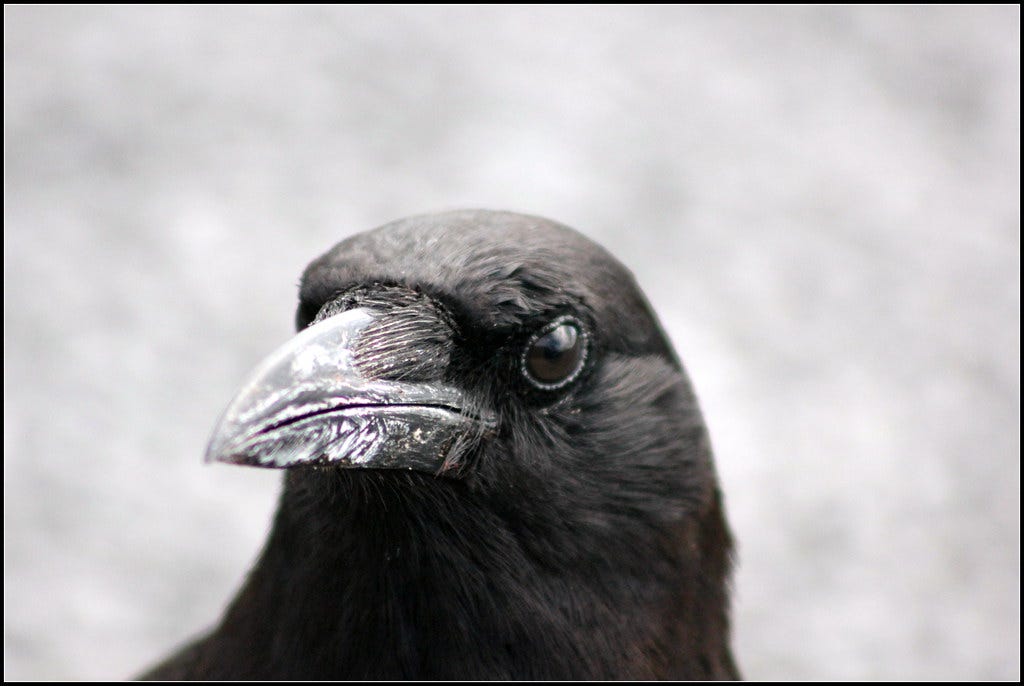
Lots of black crows share the golf course where I play several times a week. The fairways and greens at the Northwood Golf Course are carved among giant redwood trees on a bend of the Russian River at Monte Rio. Northwood is almost 100 years old and was designed by the world’s most revered course architect, Alister MacKenzie. Playing golf there is like playing in an open-air cathedral with towering and majestic living walls.
If I were a crow, I would also choose Northwood’s protected and preserved forest to live in. But who am I to tell a crow what to think or do? If you know anything about crows at all, then you know they are extremely capable of thinking for themselves.
Do you have any crows in your life? Too bad if you don’t. They are fun, mischievous and gifted creatures to be around. They can do surprising things, but they act very suave and cultured as well. They can get very chatty among a small group, but in solo they can take on the visage of a black-robed monk practicing his silent vows.
There is one crow that hangs out very close to Northwood’s pro shop and first tee, almost all day, every day. He (or she) feeds himself by stealing golfers’ snacks from their parked golf carts or unattended golf bags. This crow really, really likes French fries, but will eat anything else that golfers will eat.
This Northwood crow might easily be the happiest and best fed bird on the planet. I’ve seen him eat most of a hamburger and bun, sunflower seeds, cookies, a Mars candy bar and half an over-stuffed deli sandwich in just one afternoon. He seldom shares, but once I saw him steal a fresh bag of sunflower seeds, peck open the bag and scatter the seeds on the pavement for some of his crow buddies to split.
I’ve been curiously watching this bird all year and I’m pretty sure it is the same crow every time. While I’ve now learned that crows are so intelligent they can recognize different human faces, it’s us humans who can’t tell one crow from the other. Except for their size, they all look the same.
But, somehow, I feel sure this golf cart thief is the same bird I keep seeing every time I’m at Northwood. I’m so sure that I am now giving him a name: “Alister.”
Alister is part of the Corvus bird genus that also includes ravens, jays and magpies. There are about 40 different species of crows that inhabit all the regions of the globe except Antarctica and South America. The dominant crow in Europe is the Carrion Crow. More rare species live on islands such as the Gray Crow of New Guinea, the Palm Crow of Cuba and the white-necked crow that lives on Haiti. Alister is a plain old American crow, often confused with the bigger ravens that share the flyways and habitats of my local northern California.
In the wild, crows are non-choosey omnivores that eat grubs, worms, seeds, carrion, fruit, insects and small animals. In many parts of the world, crows have been thriving because they have adapted so well to urban and other human-altered environments. Crows literally go on vacations by the hordes to landfills or garbage dumps at certain times of the year.
Besides being very keen food thieves and tricksters, crows are considered to be among the most intelligent of all animals, ranked almost equally with primates, dolphins and human children.
Crows have large brains when compared to their body sizes. Don’t ever call them “bird brains” — that putdown used for someone who lacks “smarts” or mental abilities. Scientists have found that crows’ brains are segmented and developed more like a primate’s brain than other birds.
Crows can do many things besides steal a meal when no one is looking. American black crows can make and use tools from sticks and other materials. These wise birds can count and play games with one another. They have very good memories and they’ve been known to hold grudges and do tricks to get even. Crows not only hold grudges but they can communicate and pass on their grudges to other crows.
Crows are capable of very complex thinking and problem solving. There’s a famous experiment where a thirsty crow is confronted with a pitcher of water where the water level is too low for it to reach. One crow after another has solved this problem by dropping pebbles and other debris into the pitcher until the water level rises high enough to get a drink.
Crows can mimic human voices and other noises. As we said above, crows can recognize human faces and remember who treated them nicely and who didn’t. They are known to leave behind gifts and they’ve also been traced to steal people’s mail, raid backyard ornaments and fly away with a set of car keys and commit other pranks.
Most crows live very nice lives as members of extended families where older siblings sometimes help raise the newest hatchlings. Crows are a protected species in most regions of the world and their average life range is 5-10 years. The oldest crow known was a 59-year-old bird that lived in captivity.
Crows, like a few other animal species besides humans, participate in funerals. They gather around a dead body and seem to communicate about any dangers or lessons to be shared.
Generally, crows do not make good pets but they can make good companions. Unlike dogs, for instance, crows are too intelligent to be too submissive or tamed. It is their independence and trickery that has made them the subject of so many myths and historical legends.
The Greek god Apollo was circled by faithful crows that aided him with his prophecies. In Celtic lore, the warrior goddess Morrighan would often appear to her subjects as a crow or raven. In earlier Norse mythology crows also were the helper spirits of the all-powerful god Odin. He was often depicted with a crow sitting on each of his shoulders, whispering secrets or their latest sightings in his ear.
Across the middle plains of North America, there were many native tribes of the Apsáalooke or Absaroka which translate to “children of the large-beaked bird” — a crow or raven. Some of the tribes with Crow clans include the Chippewa, the Hopi, the Tlingit, and the Pueblo tribes of the American Southwest.
In some Southeast Asian cultures, crows used to be trained to be “watch dogs.” Because the birds could recognize different human faces, they could be trained to make different warning calls whenever a stranger was near.
How intelligent, really, are crows? One battery of tests that has been repeated by various researchers has measured some individual crows’ I.Q.s to be equal to or greater than an “average” 7-year-old human child — a second-grader who is just beginning to learn letters, words, reading and math.
Crows are masterful mimics and some have been taught vocabularies totaling over 100 words. Crows have been taught to “speak” whole sentences. And these feathered laboratory subjects have been taught to count aloud up to seven.
But you have to be careful what you teach a crow. Some of these wise birds have learned to mimic their master’s voice in order to call dogs or taunt other nearby animals and neighbors.
Back at Northwood, Barbara, a fellow golfer, has been trying to feed Alister from her hand to make him become her friend. So far, Alister doesn’t seem to be hungry enough to need any human handouts. Or, more likely, he probably prefers the thrill and conquest of stealing his own illicit smorgasbord.
— Rollie Atkinson
6-24-2026
Another great read Rollie,,, now I know what you are doing sitting there waiting for a space to open to go chase your little white ball! :)
A perfect Sunday read!