They don’t make heroes like they used to. But, then again, they never really did. Even Achilles had a vulnerable heel. And Hercules, considered by many to be the bravest hero-warrior of all, was accidently poisoned by his wife. Talk about a non-heroic and pedestrian ending. Another truth is there are many more “fallen” heroes than there is the everlasting kind.
It seems Time has a way of catching up to the myths and measures of our selected idols, heroes, celebrities and deities. None may succumb to an arrow-pierced heel like Achilles, but many, many are found to have “feet of clay.”
And, now we have the case of Civil Rights and farmworkers hero Cesar Chavez. Or, now we must say, an “ex-hero” since the March 16 New York Times’ exposé about his previously unreported history of sexual predation and abuse of under-aged girls. Seldom, if ever, has a hero fallen so far and so fast as we all are about to witness.
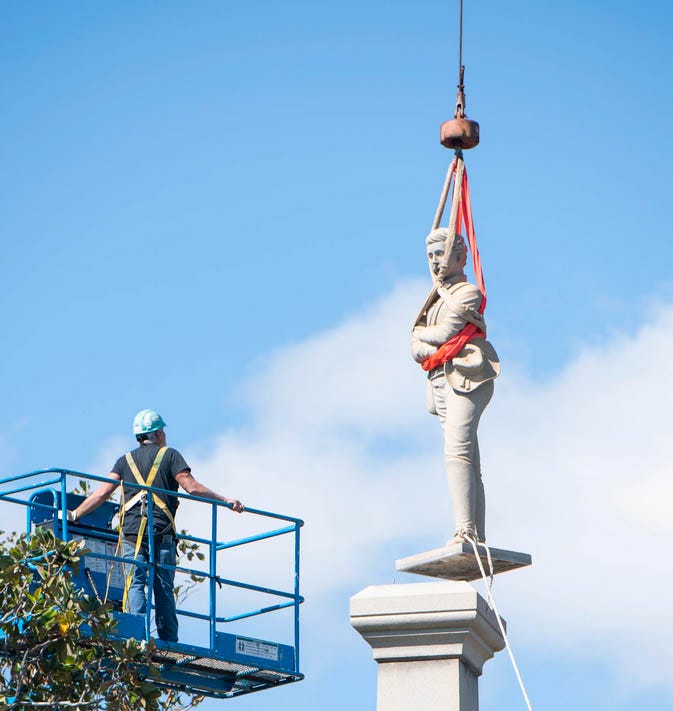
It hasn’t been that long since we tore down all the statues and monuments of U.S. Civil War Confederate war heroes. And now it looks like we will be witnessing the “un-naming” of hundreds of schools, streets, parks and an official holiday previously established to honor Chavez, who died in 1993.
Consider upgrading to paid or renewing today. Many thanks to all my faithful and engaged readers.
Who wants to be a hero?
Our Hero Game is tricky. Why do we even have to have heroes in the first place? It seems like we put them on a high pedestal just so we can knock them off of it later. What’s up with that? Scholars and others say that we need heroes to be our role models and remind us of our highest values, beliefs and ideals. Collectively, as a society, we seek role models that can be our solid touchstones and our sources of aspiration.
Besides all the mythological and historical heroes, we all make up personal heroes from our own lives. Some of us look to grandparents from a wiser age and generation as heroes and role models. Sometimes we “worship” our mothers or fathers for building us a life with their hands and hearts and selflessness. Others of us have sports coaches, special teachers, a work mentor or spiritual figure we call our heroes. When someone is “saved” from a house fire, auto accident or drowning accident, we usually call that “first responder” a hero, even when that person says he or she was “just doing my job.”
Blue Ribbon Heroes
In sports, at work, or in a moment of a family or community emergency, who among us has never dreamed of being a hero? At least for a day? Isn’t that what Blue Ribbons are for?
We find our heroes in all walks of life, most notably in statesmanship and politics, in battles and war, and in the arts and at the front lines of cultural and social change, the place we first found Cesar Chavez. Our heroes are men and women who show us courage and bravery, integrity and selflessness, compassion and vision. They are our shield against fear and dangers and uncertainty.
Where we can’t find enough contemporary heroes we go find them in ancient mythology, in fiction and folktales and always in our movies where all the “super heroes” dwell like Superman and Batman.
Once upon a time the most popular kind of heroes were firemen, cowboys, nurses and astronauts. And, of course we’ve always had our historical heroes like Washington, Lincoln and Elvis and Springsteen.
But times are more confusing now and all our real life heroes, like Chavez, have complex lives and checkered (at best) resumes. Dr. Martin Luther King, Jr. was unfaithful to his wife, Coretta. John F. Kennedy and his brother Robert both snuck women into The White House late at night. Our country’s founding fathers, including Washington and Jefferson, were slave owners. And we’ve had other heroes like Charles Lindbergh, Albert Einstein, Henry Ford and the Hollywood moguls who were racists, bigots and anti-Semites.
Sometimes, one man’s hero (Mao, Marx, Trump) is another man’s villain. Maybe we should stick with the Super Heroes from the comic books. Superman or Batman would never let us down, would they?
Do you believe you can separate the hero figure and his good deeds from his or her “personality flaws?” Even Jesus Christ confessed that he was a sinner. But it looks like some behaviors or transgressions like the ones being alleged against Chavez are too grievous to cast aside. Where would you draw the line? It’s a mistake to hope all our heroes are perfect, so maybe we shouldn’t build our hero pedestals so high.
Time is not always kind to heroes
One of the greater risks of our Hero Game is that Time keeps marching on even after our heroes’ triumphs and tributes become entombed in marble or historical records. As times change, so do our cultural standards and evolving ideologies. Fighting in a war to preserve slavery is no longer considered a heroic act. Males are no longer granted dominion over females and all excuses for ethnic prejudice and bigotry are no longer considered only “minor” character flaws.
The case of Cesar Chavez is extra troubling because he was a man who took great personal risks, fought against extremely long odds and multiple nemeses. He was a singular leader of a decades-long labor rights campaign that won dignity and new opportunities for millions of migrants and farmworkers.
If there existed a Mt. Rushmore for civil rights champions, Chavez’ sculptured head might be carved there next to Dr. King’s, Gandhi’s and Nelson Mandela’s. We guess it’s fortunate there is no such monument because no one will have to face the ordeal of chiseling or dynamiting Chavez’ likeness into fallen granite dust.
The horrid revelations about Cesar Chavez’ sex abuses have shattered his followers and current farmworker and civil rights leaders. “This is crushing news — immoral, harmful and selfish,” said the Rev. Dr. Robert M. Franklin Jr., a former president of Morehouse College. “Our respect and evaluation of Chavez must be revised, downward, but his positive impact and efforts to advance migrant worker rights stands on its own as noble and lasting.”
Delores Huerta, now 95, was Chavez co-leader at the United Farmworkers Union for three decades from the 1970s onward until his death. Last week she testified that she was a repeat victim of Chavez’ sexual attacks. She said she kept her 60-year secret to protect the reputation and advancements of the farmworkers’ movement. “We must continue to engage and support our community, which needs advocacy and activism now more than ever,” Huerta said. “I’m in mourning. It’s like losing a dear friend that you thought was almost a saint.”
God is quoted several times in the Old Testament of The Bible where he warns about making “false idols or gods.” That makes it our own fault if we practice too much hero worship. “You shall have no other gods before me. You shall not make for yourself an image in the form of anything in heaven above or on the earth beneath or in the waters below,” God is quoted as saying in Exodus 20:3-5. Other scriptures quote God as being a “jealous god” who forbids the anointing of other gods, idols or hero-deities.
Still, it seems at least as much as ever, our culture and society needs godlike role models, bold and honest leaders, courageous rebels and activists and spiritual visionaries.
We obviously need all the help we can get if we’re going to keep playing this Hero Game. It would be great to build more monuments in the future than to keep tearing down the old ones.
You mentioned that some of our founding fathers were slave holders. The fact that they "owned" human beings was bad enough. It was also not uncommon that slave owners routinely broke up families by selling off husband's, wives and children. Nor was it all that uncommon to"selectively" breed the enslved women in order to improve their chances of better offspring like they would their herds of sheep, beef, or other "animals".
Many slave owners also had sexual relations with their slaves. Some, like Jefferson, seemed to actually love their partners, but did not necessarily free their enslaved partners. Would not such a distorted relationship today be viewed as rape?
Most enslaved person were forbidden to learn to read or write, so their stories will never be known. It is likely, however, that at least some if our founding fathers were guilty of rape and human trafficking.


You mentioned that some of our founding fathers were slave holders. The fact that they "owned" human beings was bad enough. It was also not uncommon that slave owners routinely broke up families by selling off husband's, wives and children. Nor was it all that uncommon to"selectively" breed the enslved women in order to improve their chances of better offspring like they would their herds of sheep, beef, or other "animals".
Many slave owners also had sexual relations with their slaves. Some, like Jefferson, seemed to actually love their partners, but did not necessarily free their enslaved partners. Would not such a distorted relationship today be viewed as rape?
Most enslaved person were forbidden to learn to read or write, so their stories will never be known. It is likely, however, that at least some if our founding fathers were guilty of rape and human trafficking.