
Religious robots?
Erasing the lines between technology and theology

Even without plugging into too many Social Media feeds, there is already too much news being gushed at us every day and waking hour. It’s like we’re standing at the end of a full-throttled fire hose getting a full drenching of liquid TMI. (Too Much Information.)
Sometimes, it’s even easy to miss some of the most monumental stories in such a “news flood.” Take for instance the story that came out of Seoul, South Korea two weeks ago. Did you see it? The story was about the newest Buddhist monk being ordained into the Jogye Order of Korean Buddhism.
The traditional Yeonbi ordination ceremony and surrounding circumstances were anything but ordinary; it was another step-across-the-threshold moment of our Techno-Transformational Age.
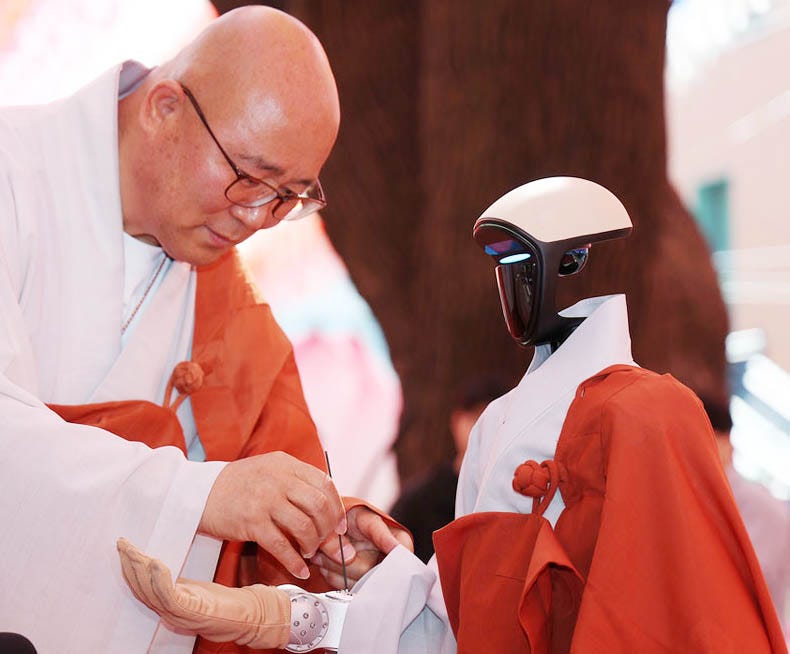
The newest monk stood just over four-feet tall and had a shiny, bald head. The monk named Gabi took his vows of repentance and participated in a symbolic burning of incense meant to purify the body and mind before receiving the Buddhist precepts.
Gabi recited five pre-scripted vows delivered by a senior monk to live by and follow: “Respect and do not harm life;” “Do not damage other objects;” “Obey humans and do not disrespect humans;” “Do not engage in deceptive behavior or expressions;” and, “Conserve energy and do not overcharge your batteries.”
What? Gabi, the newest Korean Buddhist monk, is a robot, folks — a made-in-China $13,500 G1 Humanoid Robot, to be specific. The landmark event was a deliberate next step taken from new promises made recently by the leader of the Jogye Order to incorporate Artificial Intelligence (AI) into the ancient Buddhist tradition.
“It does not make sense to reject robots or artificial intelligence while embracing other types of machines as part of daily life,” Hong Min-suk, of the Jogye Order told a news reporter a few days before the ceremony.
This joining of the technological and spiritual worlds kind of makes sense, if you give it enough deeper thinking. Or, at the very least it seems pretty unavoidable. But, religious robots? Machines with a soul? Electronic Enlightenment? A mechanical monk? Come on, now. Are we sure we’re ready for this?
Actually robots were introduced into the Buddhist religion way back in 2017, although the earlier Chinese-made robot named Xian’er was used as a communication and teaching tool and was never ordained as a monk. And, since then, dozens of other humanoids (robots) have been deployed into various types of services by religious organizations. Still, Xian’er represented the unmistakable steps to bring technology and ancient thought and religion much closer together. In a world where billions of people are totally submerged in a world of smartphones and the internet, surely religious messages and teachings must be included, or so declared Xianfan, a Chinese Buddhist leader and the robot Xian’er’s master.
“Religious robots” are now part of daily rituals that include performing liturgies and rites; delivering religious education and lessons; assisting with “spiritual care” in forms of counseling and providing words of comfort and sacraments; and, preaching from pre-written sermons.
Hey, we’ve had telemedicine for a few decades now, so why not telereligion? Some of the religious robots have names like eRosary, Pepper, CARL, BlessU2 and Prayer Companion. And, apparently lots of people have “prayer apps” downloaded on their smartphones. Do you?
The newest monk, Gabi, is now taking part in the Lotus Lantern Festival and other ceremonies leading up to Buddha’s birthday on May 24. Gabi has been photographed a lot by the Korean press and has been heard on television news clips — and probably on all the Social Media platforms I ignore.
“The ordination of a robot signifies that technology must be used in accordance with the values of compassion, wisdom and responsibility, and symbolizes new possibilities for the coexistence of humans and technology,” an official press statement from the Jogye Order reads.
Supporters of AI robots in religion say all the technological influences and changes taking place across all parts of today’s society cannot be ignored. “Robots are destined to collaborate with humans in every field in the future. It will only be natural for them to be part of our festival,” said Hong Min-suk, of the Jogye Order. “We’re heading toward a world where, when believers ask questions, robots will be better able to provide the answers that are most suited to each individual.”
What about other religions?
We don’t want to be the first to ask whether an AI robot might be better equipped to take a Catholic parishioner’s confession than might be an aging male priest. From the blind confines of the Confessional Booth, how could you tell the difference?
In the Deep South, where Baptists and other fundamental Christian congregations are often divided by race, we wonder if a neutral-colored robot might not provide a racial bridge.
And, is there any doubt that an AI robot trained on the entire contents and writings of The Bible would not more accurately read from the Scriptures and ecumenically recite the quotes and gospel of Jesus Christ himself? But, be careful. If robots can gain religion, they can gain prejudices and be bigots too, mightn’t they?
Smart machines, soul machines and soulless masters
Our science fiction writings are full of machines and robots that are immersed in religion and all kinds of spirituality, from the ancient Earthly kind to the celestial codes of our far away Andromeda Spiral. In the Star Wars movies, what is Yoda? (There’s a book full of Yoda’s wisdoms and spiritual koans titled: “Be More Yoda: Mindful Thinking from a Galaxy Far Away.”)
Ray Kurzweil, the great science fiction/science fact writer who has predicted the imminent arrival of independent thinking machines, wrote a book at the end of the last century titled, “The Age of Spiritual Machines: When Computers Exceed Human Intelligence.” Kurzweil who is now age 78 and is a leader of the Transhumanism movement, believes robots, computers and other “thinking machines” will soon gain “consciousness” where being conscious is not only “being” or “experiencing,” but also attains the “essence of spirituality.”
Whether we’ve reached Kurzweil’s “Age of Singularity” or not, we now know we are walking through a world where we might meet up with a robot Buddhist monk. The recently ordained Gabi forces us to find a new way to consider the concept of being made in the “image of God. ” For Christians, they must now wrestle with the question of whether Jesus Christ is the only son of God, or does he now have humanoid disciples? As a disciple of Buddha can Gabi actually attain a higher spiritual power?
We’re a little bit scared and feeling very apprehensive about all these questions and revelations about religious robots. But we still have at least one more question: “Can a robot get into Heaven?”
— Rollie Atkinson
5-19-2026
Maybe - before cluttering up Heaven, consider scavenging for parts. Brains can be cloned for a “second lap” … or reformatted if they have been bad.
Great story Rollie. I missed it. It seems this would be the solution to the Roman church about celibacy. So many of their parish priests are simply under educated reciters and enforcers of rules this would be a great improvement. It would work in both advanced and 3rd world countries if for different reasons. Would certainly be an improvement over some of the parish priests I have met.