We are now safely decades beyond the last set of statutes of limitation and, as far we know, all the original players of the series of episodes involving sightings and eyewitness stories about the Blue Ridge Mountains’ snallygaster monsters are all long ago deceased, some possibly eaten alive.
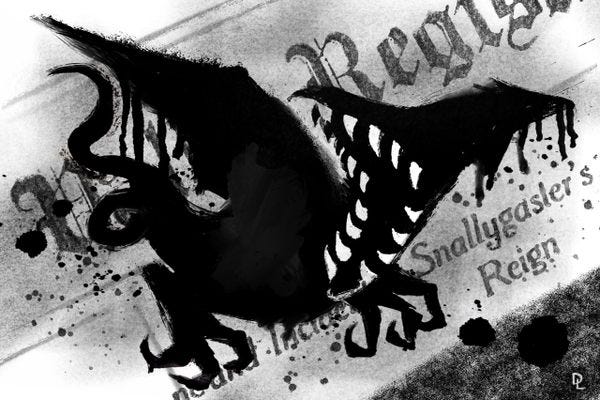
This leaves the telling of the true accounts of what happened during the final years of the half-bird, half-reptile creature’s blood-drenched and terror-filled marauding up to me, a journalist who took part in some of the original newspaper accounts at the time, in the mid-1970s.
My stories will likely be quickly dismissed by some of my readers here as “fantastical lore.” But I have real evidence to produce. I possess dispatches of undeniable and powerful circumstances and interwoven actual events to back me up. I don’t know why, but something like a pang of guilt recently overcame me. Hence, I now feel compelled to set the record straight, even though the telling will implicate me as a guilty accomplice. Believe what you will, but this is a fascinating set of stories.
The origin of the snallygaster is derived from an old German superstition about a “quick spirit” figure they called Schneller Geist. In scientific or pseudoscience circles, the snallygaster would be ne known as a “cryptid.”
Early German farmers who came to America in the 1730’s brought the fable of the Schneller Geist with them as they settled in the piedmont slopes of mid-Pennsylvania and western Maryland. The German farmers painted large, colorful seven-pointed stars (hex symbols) on their barns to ward off the Schneller Geist. The symbols didn’t help; the Schneller Geists had followed them from Europe, proven by vicious attacks on their livestock and smatterings of scary tales of sightings and near escapes by the farmers and their new neighbors.
As the German language mixed with English and other Colonial dialects in the mid-Appalachian ranges, the monster’s name became pronounced and spelled as “snallygaster.”
While there have been many recorded snallygaster sightings over a wide geography, Frederick County, Maryland is where the most reports and activity occurred through history. Frederick County is where I was born and started my long newspaper career. It also happens to be the exact location of several other “quick spirit” legends and stories.
The original Native American inhabitants of the Blue Ridge told stories about a “dwayyo,” a wild beast that changed shapes between a bear, wolf or very large dog-like creature with fiery eyes, long arms and large fangs. Unlike the snallygaster, dwayyos did not have wings or fly.
This locale of the snallygaster and dwayyo also had well-identified locations and landmarks that we natives and descendants learned to avoid, or give wide berth in our travels.
Frederick County’s Blue Ridge mountains once marked the western edge of colonial era settlements where a young surveyor named George Washington first mapped a crossing that later became the same route of the National Pike (U.S. 40) and later also was crisscrossed by the Appalachian Trail. The spiny mountain ridge sits just under 2,000 feet in elevation and, to this day, is very sparsely populated by small farms, homesteads and sites of many former bootleg whiskey stills.
The mountain ridge also rises just east of the lower fields and meadows where the bloodiest day of the U.S. Civil War was fought at Antietam Creek on Sept. 17, 1862. Thousands of the 22,726 dead and wounded from that day’s battle are buried in scattered graves and in a few military cemeteries at the preserved battlefield. The silent monuments to these violent deaths have become eerie companions to the region’s earlier “quick spirits.”
A spooky place
These locations were featured much later in the make-believe story, “Blair Witch Project,” which became a cult-favorite horror film in 1999 about film students who ventured too close to the local’s known forbidden terrain of the “quick spirits.” The film takes place in Burkittsville, a pre-Civil War village that to this day appears stuck in time of 175 years ago, with the same small population of just 142 people.
Neither the snallygaster or the dwayyo make an appearance in the Blair Witch Project film, but their spirits are felt to be looming just off-camera in the foggy terrain of the Blue Ridge woods and remote cemetery where most of the film takes place.
The release of the film and its widespread popularity rekindled local interest about all the other spooky history of Burkittsville and the surrounding mountains and old farms. It spurred — for the third time — the reissuing and publication of original local newspaper accounts of the fabled monster sightings, hysterical eyewitness stories and faded photos of attacked livestock and wispy shadows of the cryptids in retreat.
My involvement with these retellings took place in 1976-77 at the Frederick News-Post newspapers. A rash of livestock maulings and pet dog killings got excited readers to recall a similar wave of alleged snallygaster or dwayyo activity from just a decade before in 1965.
But the earliest — and best-documented — newspaper accounts dated to 1909 when another local newspaper, the Middletown Valley Register, had reported multiple sightings by local residents of a beast with “enormous wings, a long pointed bill, claws like steel hooks, and an eye at the center of its forehead.”
There were so many reports of the monster sightings that the Smithsonian Institute offered a reward for its capture and recently retired U.S. President Theodore Roosevelt, an accomplished wild animal hunter, considered delaying an African safari to join the snallygaster hunt.
Roosevelt demurred and never joined the hunt just as the Valley Register’s editor George C. Rhoderick and reporter Ralph S. Wolfe confessed to their readers that all the snallygaster reports were part of a contrived hoax to boost their newspaper’s readership.
That didn’t stop the spread of snallygaster stories. A few months later, a farmer in nearby Sharpsburg, West Virginia, just across the Potomac River from Burkittsville and Middletown, said he was attacked by the flying monster and he claimed to be in possession of a snallygaster egg. Another snallygaster was reportedly seen flying over Casstown, Ohio and there were other sightings in nearby Montgomery and Carroll counties and farther away in Columbia, New Jersey and in Arrow Point, Missouri. But, thereafter the raft of snallygaster encounters quieted.
The Snallygaster returns — again
But in 1965, the monster attacks returned to Frederick County’s cursed mountains. “It had to happen sooner or later,” News-Post reporter George May wrote on Nov. 27, 1965, under a headline, “You’d Better Watch Out: Dwayyo Could Be A Modern Snallygaster.”
A Burkittsville resident had called the News-Post newsroom to report a possible hatching of snallygaster eggs and the emergence of a dwayyo. May embellished his news account with a full telling of the history of the German’s Schellner Geist and the half-bird, half-reptile snallygaster. May reminded his readers that “the origin of the snallygaster remains unknown, but some reports indicate the creature in the past had often scared many local moonshiners.” May added that the monster was known “to prey on children and poultry.”
Then, again in 1976-77, News-Post police and court beat reporter George Dorsey, a newsroom colleague of mine, took an entry from a daily police log about a rash of livestock and family pet attacks between Burkittsville and Middletown and added a suggestion about whether a snallygaster had been resurrected in a new decade. Within days, calls about additional livestock and pet attacks came into the News-Post newsroom. I remember passing on a few calls to Dorsey’s desk, only to read his sensationalized reports the next morning in our paper.
Dorsey, a diligent newsman with an apparent mischievous side, died in 2020 at the age of 76. I am here to say that George strayed from the stout, objective news ethics he applied for decades in his court and crime reporting when he filed his snallygaster log items. I’m sure he meant no harm but it appears the snallygaster has outlived him.
A Snallygaster Beer Festival will be held in October, 2026 for the 14th year in a row in Washington, D.C. There is a Snallygaster Café & Bar in Harpers Ferry, West Virginia, about 10 miles from Burkittsville. In Frederick County, the Dragon Distillery produces a Snallygaster Rye Whiskey.
There is a Snallygaster National Museum in Libertytown, Maryland and the Maryland Historical Trust considers the snallygaster a “piece of intangible cultural heritage.” Several books also have been written about the snallygaster and author J.K. Rowling, of Lord of the Rings fame, includes mention of the Blue Ridge’s cryptid in her collection, “Fantastic Beasts and Where to Find Them.”
There is an unsubstantiated story that a U.S. military unit once captured and killed a snallygaster and preserved its remains in a secret repository. Another report of the snallygaster’s demise has it that the creature was chased and shot by Prohibition-era “revenuers” and drowned in a vat of moonshine whiskey.
No matter the case, we’re not here today to keep alive the earlier sensationalisms of Dorsey, May or the Middletown Valley Register newsmen. Let’s just say, that’s for others to decide. But now you know “the rest of the story,” as Paul Harvey used to say.



Nice read Rollie - Perhaps an inspiration for some Halloween antics..