
Termites
Can’t live with ‘em and we can’t live without ‘em

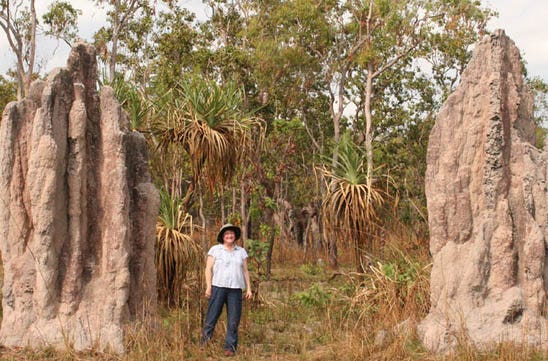
Anyone who has had their house eaten up by swarming termites probably doesn’t want to believe that our lives and the elaborate biological web that supports all other living things on our planet might not exist without those same termites.
If those stealthy little “white ants” didn’t exist, then Mother Nature or someone else would have to quickly come up with a replacement that could do all the heavy lifting termites perform at the bottom of millions of food chains, and almost always under our feet but invisible at the same time. They’re constantly busy, toiling in our soils and forests, and munching in our trash piles and other bioenergy heaps.
The ravenous appetite of these little bugs for wood and other celluloid matter is what gets them into trouble and costs homeowners and others billions in annual destruction and repairs. But this is also the trait that makes them so indispensible for helping to maintain the balance of life and the recycling of energy and essential gases throughout almost all our terrestrial biomes.
Termites are Nature’s most prolific and efficient of all bioreactors. Their tiny little guts are filled with microbes that cannot be found anywhere else on Earth, numbering in the hundreds. When they eat wood and other fibrous debris, termites produce atmospheric methane and hydrogen that are essential building blocks for other organisms, including humans and their domesticated plants and animals. Termites are like miniature fertilizer factories and produce 200 million tons of freed hydrogen each year to replenish our soils and to feed next year’s crops. They are also good climate change nullifiers, capturing and converting copious amounts of carbon dioxide (CO2), one teensy bite after another.
Try thinking of termites like the carburetor on your car’s engine that mixes raw fuel, oxygen and other gases to propel your daily travels. The power and bio-magic of termites is so unique and irreplaceable that research scientists and engineers right now are trying to figure out how to harness their bioreactor talents and maybe solve some of our planet’s future needs for alternative, non-fossil fuel.
We know all about Terminix and the lucrative commercial pest control industry dedicated to killing all termites. But do you know about the promising industries of termite farms and termite biofuel laboratories?
The scientific background fact sheet
Just so you know, there is not a single creature known as a termite. Biologists now list 2,997 different species of termites. Their ancestors have been living on the planet for at least 300 million years and they can be found on all the continents of the Earth, including Antarctica. In some equatorial regions of Africa and South America, termite colonies can total more than 10 percent of the local biomass. There are 1,000 separate termite species in Africa and many have become important food sources for the local human populations.
Of the nearly 3,000 different species of termites, only about 18 are the proven culprits of all that damage to wooden shelters and homes. There’s no question they are a certified and costly domestic pest, but there are places where the human and insect populations have learned to live in a near-symbiotic existence. Some of the indigenous people of Africa model their mud and hatch huts after the tall mounds of termites to reproduce their natural air-cooling properties. In Southeast Asia, termites are part of some cultures medicinal and religious practices. There are many cookbooks around the globe that include recipes using termites.
Termites are a highly evolved social species, which scientists label as “eusocial.” They are not ants; their closest insect cousins are ancient cockroaches. They live in colonies that can amass in the millions and millions. The largest discovered colony in Brazil was found to cover an area equal in size to all of the Great Britain isles. Some scientists refer to termites as “super organisms.” They share all the tasks of brooding their young nymphs. They morph between “worker,” “messenger” and “farmer” modes. Some species have kings and queens, but other species are more amorphous in their sex lives and reproductive cycles.
If Hollywood made a movie about termites, it would get rated with an “X.” Termites aren’t born with all the bacteria in their guts that make them such special bioreactors. To acquire these necessary bacteria, termites eat each other’s poop, and sometimes eat each other. This is a scientific term called “trophallaxis,” a term that you will never need to know or use again. Or, maybe not.
Termite poop might be the future
There are a few large enterprises working to marshal all the bioreactor powers of termites and turn them into a reliable source of bio-renewable energy for human use. It’s been proven that a controlled colony of four million termites can produce enough free hydrogen to serve an average U.S. household’s energy consumption of 29 to 30 kilowatt hours per day. Such a colony of termites could be contained in a bio dome container about the size of an average farm silage silo. To produce another day’s power supply would require mounds of dry wood, cardboard or waste paper saved from a nearby landfill or trash pile. In one test, termites produced two liters of hydrogen from a single sheet of paper.
Before you go out and start your own termite farm, you should know there are the usual side effects to consider. Even in the wild, all those 2,000 species of termites continue to be a major source of the greenhouse gas methane. But termites only contribute about 10 percent of the current total of released methane which includes sources from burning fossil fuels, agricultural activities including belching cows and natural emissions from warming permafrost, oceanic exchanges and other “natural” fluxes.
Termites are not very cute creatures. Most of the various species average a half-inch in size with some species having a winged stage of development. Younger termites are almost translucent and more mature bugs gain a pale brown color. Almost all termites are blind for life but have highly sensitive communication skills via their antennae. Many termite species use their mouths and anus interchangeably for taking in or excreting nutrients and excrement.
By sheer numbers termites might be the Earth’s most widespread bioreactor and decomposer, but they get lots of help from other bugs, worms, flies, specialized beetles and creepy millipedes. A horde of termites could never match the amount of re-nourished soil a single earthworm can produce. But none of the worms or the other creatures in your compost bin can perform the chemical tricks that termites do.
Termites evolved their bioreactor process of breaking down piles of biomass into useful byproducts over 30 million years ago. They are basically fungus farmers that perform their magic by a unique division of labor where older termites in a colony collect plant material and bring it to the nest. Younger workers eat the celluloid matter (lignocellulose) and mix it with fungal spores they also digest. This compost mixture is then left to ferment briefly before a third regiment of still younger termites come along and pass the compost through their digestive tracks and excrete enhanced combinations of CO2, hydrogen and energized biomass.
If this all sounds like complicated shit, well, that’s exactly what it is. If only we could train them to be better house guests. Right?
— Rollie Atkinson
8-1-2026